In this paper, we describe LLMThings, an experimentation platform dedicated to the study and evaluation of language agents-based orchestration of IoT systems.
The platform features a real-world IoT deployment while being modular, flexible, and interactive: it allows users to define (crews of) specialized agents, extend the system with various tools (e.g., devices, APIs, AI models, external services, etc.), run experiments, and monitor various metrics of the IoT system in real-time. This makes it a suitable testbed for education, research, and development purposes.
To illustrate how the distinct functional layers of an IoT orchestrator interact under real-world constraints, we present a concrete smart nursing home deployment. The physical infrastructure comprises a heterogeneous swarm of low-power wireless devices (in blue) operating on fragmented protocols such as Wi-Fi and ZigBee. The operational objective is driven by a high-level intent expressed by a nurse through the LLMThings interface:
“Make sure that the patient does not fall wherever she goes.”
As a patient (in red) moves from the “Activity Node” towards the garden, navigating unpredictable paths through the “Living” and “Kitchen” corridors with frequent stops, the orchestrator needs to coordinate services and resources in order to satisfy the nurse’s intent while complying with severe bandwidth, energy, and computational constraints.
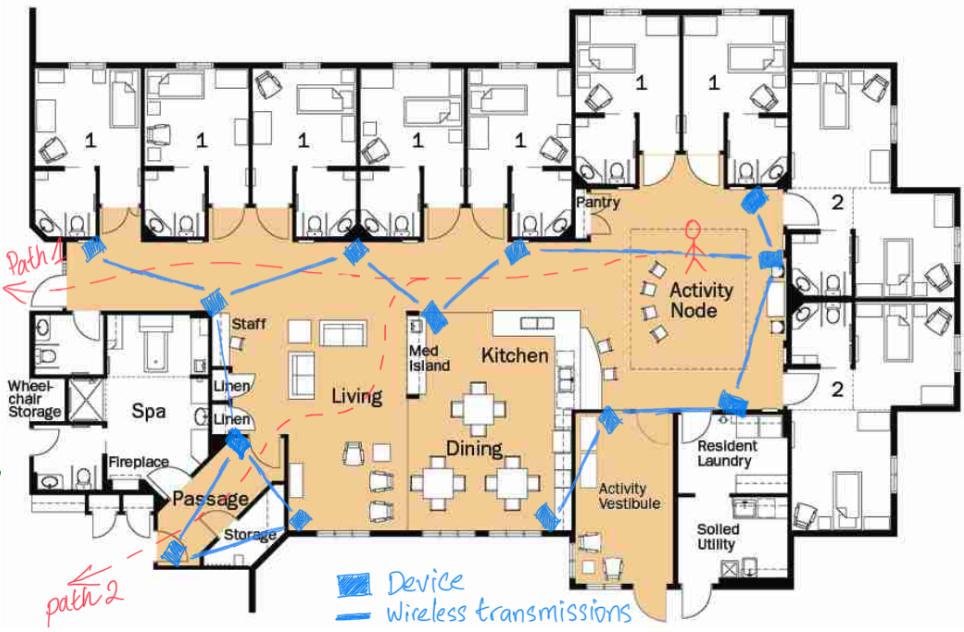
IoT system monitoring patients within the nursing home.
Orchestration generally breaks down into:
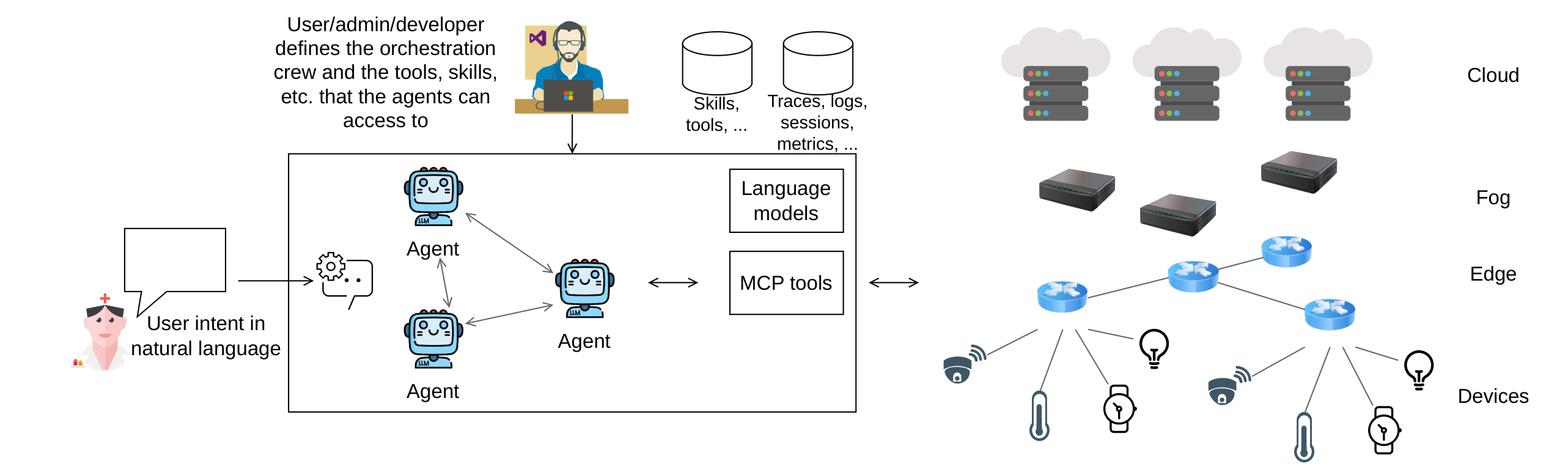
Overview of LLMThings. Practitioners (e.g., sysadmin or developer) first define the agents, their coordination, and the tools they can access. The end-user (e.g., nurse) can then express an intent in natural language, which is processed by the resulting crew of agents to orchestrate the underlying IoT system.
LLMThings allows practitioners to study, design, and evaluate language agents-based orchestration approaches in a real-world IoT system. The framework provides a modular environment in which experimenters can define specialized agents, integrate heterogeneous tools, including IoT devices, AI models, and external services, configure realistic deployment scenarios, and monitor system behavior through quality of service metrics and interactive visualizations.
The platform is designed to facilitate rapid experimentation, reproducible evaluation, and educational demonstrations while remaining sufficiently flexible to accommodate diverse research questions.
The current deployment features a real-world IoT system composed of a dozen ESP32 devices interconnected via Wi-Fi and ZigBee and a set of approx. 30 sensors (e.g., camera, motion, and temperature).
To evaluate LLMThings we investigate the use of crews of agents to implement various orchestration strategies and management loops. Notably, we implement the famous MAPE-K autonomic management loop composed of Monitor, Analyze, Plan, and Execute stages, as well as a shared Knowledge providing the information required by the different stages.
We define agents corresponding to each one of these stages and provide them access to specific tools, while enforcing a sequential coordination among them.
We want to express our gratitude to the department of computer science and the Direction de l’Offre de Formation (DOFREVA) of UEPS for their support.
@inproceedings{sadoudi2026llmthings,
author = {Sadoudi, Anais and Le Huyen-Trang and Hamidi Massinissa},
title = {{LLMThings}: Platform for Language Agents-Based Orchestration of {IoT} Systems},
year = {2026},
}